The Rise of the AI Entrepreneur

AI creates disruption. That’s not new.
What’s new is the speed and where the gains go.
AI allows companies to produce more with fewer people. That creates enormous wealth. But the wealth doesn’t automatically flow to the workers whose labour is displaced. It flows disproportionately to whoever owns the technology, the platforms, and the businesses built on top of them.
That creates a problem our existing economic playbook may not be equipped to solve.
For decades, the response to technological disruption has been familiar: let markets restructure, support the people who lose out, retrain them, and help them back into employment.
AI could move too fast for that model.
The problem isn’t simply that AI will destroy jobs. Economies have absorbed technological displacement before.
The problem is that AI can reduce the value of human labour faster than workers can adapt and potentially faster than governments can redistribute the gains.
At the same time, governments have less room to absorb the shock.
Public debt is already high. Interest costs are consuming a growing share of government budgets. Ageing populations are increasing demand for healthcare, pensions, and social support.
The fiscal cushion is thin precisely when we may need it most.
So the defining economic question of the AI era may not be:
How do we protect millions of jobs?
It may be:
“How do millions of people move from earning primarily through employment to earning through participation in the AI economy?”
That isn’t just a jobs question.
It’s an ownership question.
Protecting people from displacement won’t be enough. We need to create pathways from declining labour income to new forms of income from employee to participant, from consumer to producer, from worker to owner.
Instead of waiting for AI to generate enormous wealth and then asking governments to redistribute enough of it to keep society functioning, we should enable far more people to create and capture some of that wealth themselves.
Give people the tools.
Give them access.
Give them the ability to turn what they know, what they can do, and what they can create into something the market will pay for.
This is the rise of the AI entrepreneur.
Not the Silicon Valley founder raising millions.
The nurse who understands a problem in healthcare.
The accountant who knows a workflow that should be automated.
The tradesperson who knows an industry outsiders don’t understand.
The teacher with expertise that can become a product.
The freelancer who can suddenly operate with the capabilities of a small company.
The ordinary person with a skill, an insight, a network, or simply the determination to build something.
AI changes the economics of entrepreneurship because it dramatically reduces the cost of turning human capability into economic output.
One person can research like a team.
Create like an agency.
Build software without being a software engineer.
Market without a marketing department.
Serve customers without a large operations team.
The barrier between knowing something valuable and owning something valuable is getting smaller.
That creates an alternative path.
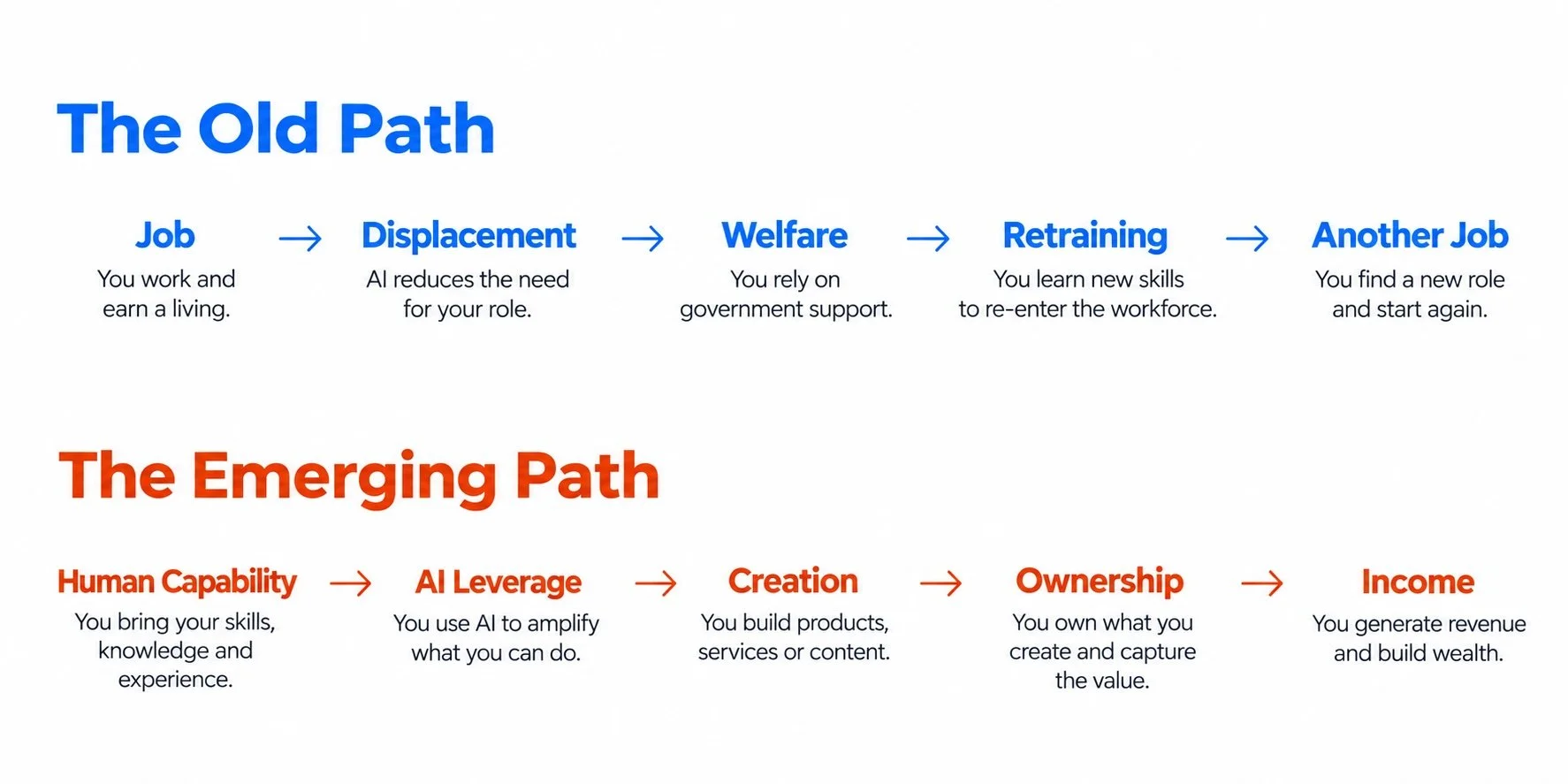
This won’t eliminate the need for a safety net. Nor will everyone become an entrepreneur.
But if AI really does weaken the relationship between employment and income, simply building a bigger safety net underneath the old system won’t be enough.
We need to build a new economic ladder alongside it.
A market in which millions of ordinary people can use AI to become producers, creators, entrepreneurs, and owners not merely consumers of AI or dependants on the institutions that own it.
The biggest opportunity of the AI era may not be making companies need fewer people.
It may be making individual people capable of becoming companies.
That is the rise of the AI entrepreneur.
And it may be one of the most important economic transitions of our time.